

RFK Jr., EMF Safety, and the Debate Over Wireless Health Risks

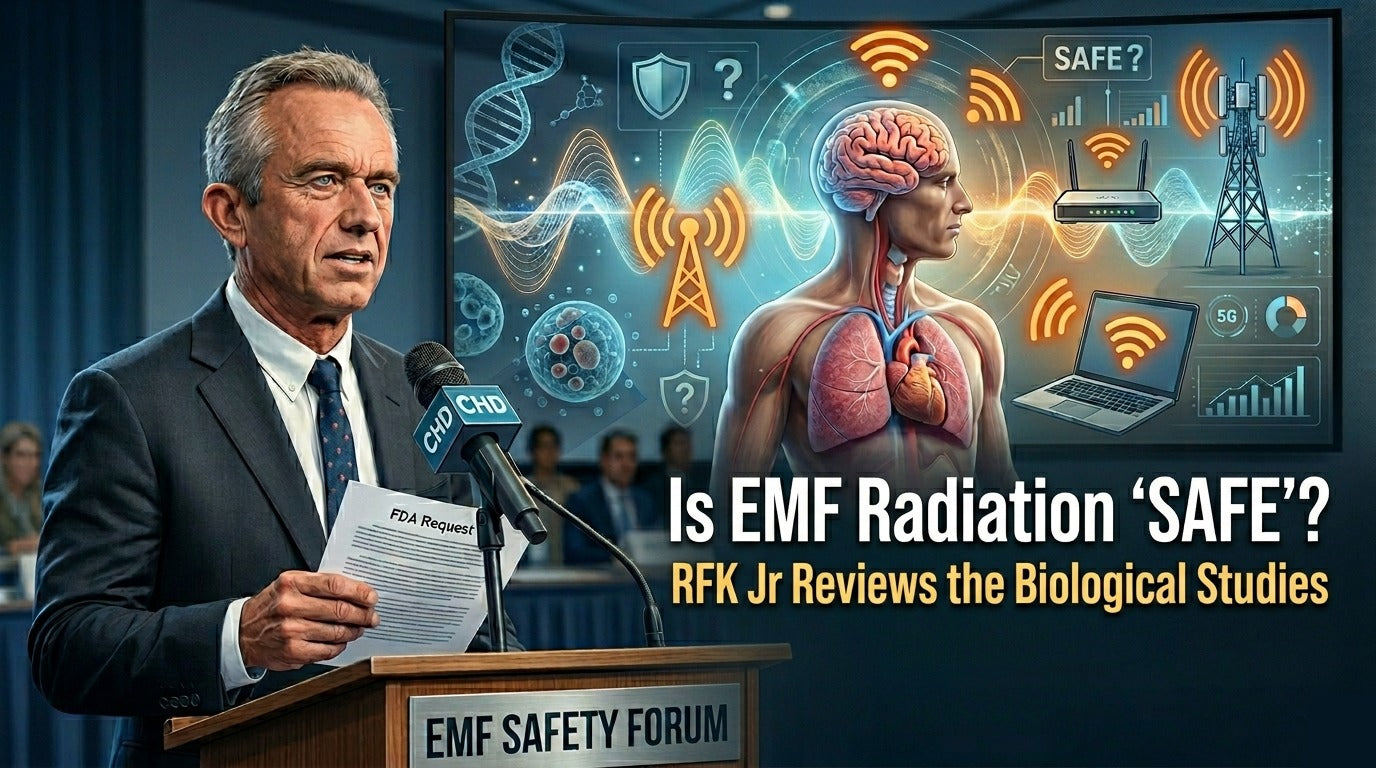
RFK Jr, head of the US Health and Human Services department, and self-proclaimed 'Make America Health Again' tsar, told the FDA to remove from its website the claim that Electromagnetic field radiation (EMF) is 'safe', while his team performs a full review of the biological studies that indicate that it is harmful.
This article covers all the history behind this decision, including RFK Jr's court case with the FCC where he sued them for not updating their safety standards since 1996, in the light of masses of evidence of biological harm in animal studies, and he won the case.
Table of Contents
- Understanding EMF and Wireless Radiation
- The FDA’s Position on EMF Safety
- RFK Jr.’s Request for FDA Policy Reassessment
- The 2021 FCC Court Case Explained
- Biological Effects vs. Thermal Effects
- Scientific Studies on EMF and Health
- Circumstantial Evidence of EMF Harm
- Public EMF Health Concerns and Uncertainty
- Wireless Devices in Everyday Life
- Conclusion
Understanding EMF and Wireless Radiation
What Are Electromagnetic Fields (EMFs)?
Electromagnetic fields, commonly referred to as EMFs, are invisible wave fields of energy often described as radiation. They are generated by electricity and various forms of natural and man-made invisible lighting and broadcast either from celltowers (like 5G) or from Wi-Fi routers inside buildings.
If you’ve ever used a smartphone, connected to Wi-Fi, or even turned on a microwave, you’ve interacted with EMFs, whether you realized it or not. These fields exist on a spectrum, ranging from low-frequency radiation like radio waves to high-frequency radiation such as X-rays.
The type of EMFs associated with wireless devices—like phones, routers, and Bluetooth gadgets—falls under the category of non-ionizing radiation. This classification is important because scientists have always believed that non-ionizing radiation does not carry enough energy to directly damage DNA in the way ionizing radiation can. That distinction has long been central to regulatory agencies’ confidence in the safety of wireless technologies. However, critics argue that focusing solely on ionization overlooks subtler biological interactions that may still matter over long periods.
To understand the debate, think of EMFs like sunlight through a window. You may not feel an immediate burn, but prolonged exposure could still have cumulative effects. This analogy is often used by researchers who believe that chronic, low-level exposure deserves more scrutiny than it has historically received.
As wireless infrastructure continues expanding—from 5G towers and even satellites to smart homes—the background level of EMF exposure has increased dramatically over the past two decades. This shift has raised new questions about whether older safety assumptions still hold up in a world where people are constantly surrounded by connected devices that are hungry for data.
Everyday Sources of EMF Exposure
EMF exposure is no longer limited to occasional device use; it’s embedded into daily life. Smartphones are perhaps the most obvious source, typically carried in pockets, held against the head, or placed near the body for extended periods. Wi-Fi routers operate continuously in homes, offices, and public spaces, emitting low-level radiation around the clock.
Other common sources include:
-
Bluetooth devices like earbuds and smartwatches
- Laptops and tablets connected wirelessly
- Cell towers and 5G infrastructure
- Smart home devices such as thermostats, smart meters and voice assistants

What makes modern exposure unique is not just the field strength but also duration of use and proximity. A person might spend hours each day with a phone inches from their body, sleep near a Wi-Fi router, and work in environments saturated with wireless signals. This constant exposure pattern is brand new in human history.
Some researchers argue that regulatory frameworks were designed for older technologies where exposure was intermittent, not continuous. That difference lies at the heart of current debates, including those raised by Robert F. Kennedy Jr. and advocacy groups like Children’s Health Defense.
While mainstream scientific organizations maintain that current exposure levels are within safe limits, the sheer ubiquity of wireless devices has led many to question whether “safe” should be defined differently in an always-connected world. The conversation is no longer just about whether EMFs are harmful, but whether existing guidelines adequately reflect real-world usage patterns.
The FDA’s Position on EMF Safety
Historical FDA Statements on Wireless Radiation
For years, the U.S. Food and Drug Administration (FDA) has maintained that the available scientific evidence does not show a clear link between wireless device use and adverse health effects. This position has been shaped by reviewing decades of research, including large-scale epidemiological studies and reviews conducted in collaboration with organizations like the World Health Organization (WHO) and the Federal Communications Commission (FCC).
The FDA has consistently emphasized that exposure levels from consumer devices fall well below thresholds known to cause harm. Their assessments have largely focused on thermal effects, meaning whether EMF exposure can heat body tissues to dangerous levels. Since wireless devices operate at power levels too low to cause significant heating, regulators have historically concluded they are safe under current guidelines.
In public statements, the FDA has pointed to studies such as the National Toxicology Program (NTP) research, which investigated potential cancer risks in animals exposed to high levels of radiofrequency radiation. While some findings suggested possible associations, the FDA interpreted the results as not directly applicable to typical human exposure scenarios. The key word here is 'interpretation'.
This stance of selective disassociation has shaped public perception for years. For most consumers, the message has been simple: wireless devices are safe when used as intended. However, critics argue that this messaging may oversimplify a complex and evolving body of research.
Why the FDA Has Considered EMFs Safe
The FDA’s safety determination rests on several key pillars. First is the distinction between ionizing and non-ionizing radiation, with the latter considered significantly less dangerous. Second is the reliance on established exposure limits set by the FCC, which are based on preventing harmful thermal effects.
Another factor is the lack of consistent, reproducible evidence showing harm at exposure levels typical of everyday device use. While a large number of studies have shown biological effects to be caused, many others have failed to replicate those findings. This inconsistency has made it difficult for regulators to justify changing safety standards.
There’s also the issue of risk versus benefit. Wireless technologies have become essential for communication, healthcare, education, and emergency services. Regulators must weigh potential risks against these societal benefits, often erring on the side of maintaining access while continuing to monitor emerging research.
Still, this framework has been criticized for being too narrow. Opponents argue that focusing primarily on thermal effects ignores a growing body of literature exploring non-thermal biological interactions, such as oxidative stress, cellular signaling changes, and potential impacts on brain activity.
This tension between established regulatory science and emerging research is exactly where RFK Jr.’s recent actions—and his earlier legal challenge against the FCC—enter the conversation.
The 5G Senate Hearing: Zero Dollars Spent on Safety Testing
It's worth noting that in 2021, Senator Blumenthal conducted a US Senate hearing with representatives from the Telecoms industry to ask them how much health and safety testing they had conducted on the 5G network.
The response from 5G executives was astonishing. They admitted that there had been no safety tests and that zero dollars had been spent on this aspect of the new network. This is a cause for concern for all of us, because all electrical grids and circuits should be installed with protection for the public as highest priority. The same procedures that would be applied to an electricity grid, for example, were completely bypassed during the rollout of 5G.  ----------------------------------------------------------------------------------------------
RFK Jr.’s Request for FDA Policy Reassessment
The Push to Remove “Safe” Language
Robert F. Kennedy Jr. has stepped directly into one of the most contentious scientific and regulatory debates of the modern era: whether wireless radiation is truly as safe as agencies claim. His recent request urging the FDA to remove or reconsider language that broadly declares EMF exposure “safe” marks a significant moment—not because it proves harm, but because it challenges the certainty of existing assurances.
If it transpires that there is a health risk of using wireless devices that was overlooked by the FDA or the FCC, it means that billions of people will have been affected over the last 25 years.
The core of this request isn’t necessarily that EMFs are definitively dangerous. Instead, it questions whether regulators have been prematurely definitive in their conclusions. By asking the FDA to revisit its wording during an ongoing review of biological studies, RFK Jr. is essentially arguing that public messaging should reflect scientific uncertainty more transparently.
Why does wording matter so much? Because terms like “safe” carry weight. They shape public behavior, influence industry standards, and often determine whether further research is prioritized or dismissed. If something is labeled safe, the urgency to investigate potential risks tends to fade. RFK Jr.’s position suggests that the science may not be settled enough to justify that level of confidence.
This push also reflects a broader philosophical divide. On one side are regulators who rely on consensus-based science, requiring strong, repeatable evidence before changing guidelines. On the other side are advocates who believe early warning signs, even if incomplete, should trigger precautionary measures.
In practical terms, removing or softening the “safe” label wouldn’t ban devices or even necessarily change exposure limits overnight. But it could shift how risks are communicated to the public. It might also open the door for updated guidelines that consider newer forms of exposure—like constant proximity to multiple wireless devices throughout the day.
The Scope of the Independent Review
The independent review being pushed into focus centers on a crucial question: Are current safety standards missing important biological effects? This isn’t about dismissing existing research but expanding the lens through which EMF exposure is evaluated.
Historically, most regulatory reviews have prioritized studies that examine thermal effects—essentially asking whether radiation heats tissue to harmful levels. The independent review, however, aims to dig deeper into non-thermal biological impacts, which may occur without any noticeable temperature change.
These include areas like:
-
Changes in cellular signaling pathways
-
Potential impacts on oxidative stress levels
-
Effects on brain activity and sleep patterns
-
Long-term exposure outcomes observed in animal studies
The review is expected to revisit research that some critics argue was overlooked or undervalued in previous assessments. This includes studies involving chronic exposure in animals, where subtle biological changes were observed even at levels below current safety limits.
At Omnia Radiation Balancer, we know that there is a mechanism for harm in low frequency, non-thermal radiofrequency radiation that everyone overlooks: it’s the way the radiation field vibrates.
One of the most debated aspects is how to interpret these findings. Biological effects do not automatically equate to harm. The human body responds to countless environmental stimuli every day. The challenge lies in determining whether these responses are adaptive, neutral, or harmful over time.
RFK Jr.’s involvement has brought renewed public attention to these questions, but it’s important to note that the outcome of such a review is uncertain. It could reinforce existing standards, suggest minor adjustments, or recommend more significant changes. What’s clear is that the process itself signals a shift toward re-examining assumptions that have been in place for decades.
The 2021 FCC Court Case Explained
Background of the Lawsuit
The legal foundation for much of today’s debate can be traced back to a pivotal 2021 case: Environmental Health Trust et al. v. Federal Communications Commission (FCC). This lawsuit challenged the FCC’s decision to maintain its existing radiofrequency exposure limits, which had not been significantly updated since the 1990s.
At the heart of the case was a simple but powerful claim: the FCC had failed to adequately consider a growing body of scientific evidence on the biological effects of EMF exposure. The plaintiffs argued that the agency relied too heavily on outdated assumptions and did not sufficiently address newer studies, particularly those involving long-term and non-thermal impacts.
The timing of the case was significant. Wireless technology had evolved dramatically since the original standards were set. Smartphones, Wi-Fi, and now 5G networks had fundamentally changed how (and how often) people are exposed to EMFs. Yet the regulatory framework remained largely the same.
This disconnect between technological advancement and regulatory updates became a central issue in the lawsuit. It raised a broader question: can standards designed for a different era adequately protect people in today’s hyper-connected environment?
Role of Children’s Health Defense
RFK Jr., through his involvement with Children’s Health Defense (CHD), played a prominent role in supporting the legal challenge. The organization has been vocal about potential environmental and technological health risks, particularly those affecting children.
CHD argued that children may be more vulnerable to EMF exposure due to factors like developing nervous systems and thinner skulls, which could theoretically allow deeper penetration of radiofrequency radiation. While this remains an area of scientific debate, it has been a key point in advocating for stricter safety standards.
The lawsuit also emphasized the need to consider cumulative exposure. Unlike earlier generations, children today are exposed to wireless signals from birth, and often continuously. This lifelong exposure pattern is something that older safety guidelines did not fully account for.
By bringing these concerns into a legal setting, CHD and its collaborators forced a level of scrutiny that goes beyond academic debate. Courts require agencies to justify their decisions with clear reasoning and evidence, making the case a critical moment in the ongoing discussion about EMF safety.
The Court’s Ruling and Its Implications
In a notable decision, the U.S. Court of Appeals for the D.C. Circuit ruled that the FCC had not adequately explained its reasoning for maintaining its existing exposure limits. The court did not declare EMFs unsafe, but it did find that the agency failed to properly address certain evidence and concerns raised in the record.
This distinction is crucial. The ruling wasn’t about proving harm—it was about accountability and thoroughness. The court essentially told the FCC: you need to do a better job explaining how you evaluated the science.
The implications of this decision are still unfolding. It doesn’t automatically change exposure limits, but it does increase pressure on regulators to revisit and potentially update their assessments. It also lends credibility to arguments that more comprehensive reviews are needed.
For the public, the ruling adds another layer of complexity. On one hand, regulatory agencies still maintain that current limits are safe. On the other hand, a federal court has acknowledged gaps in how those conclusions were reached.
This tension underscores the broader theme running through both the lawsuit and RFK Jr.’s recent actions: the science of EMF exposure is not entirely settled, and the way it is interpreted can vary depending on which evidence is emphasized.
Biological Effects vs. Thermal Effects
What Current Safety Standards Measure
Current EMF safety standards are built around a relatively straightforward concept: preventing harm caused by tissue heating. This is measured using a metric called the Specific Absorption Rate (SAR), which estimates how much energy the body absorbs from a device.
What happens is they have a fake model of a human being, with fake skin that is filled with fake blood. Then they place a phone next to the fake skin and see if any heat is detected in the fake blood.
However there is a problem with SAR testing: there is no brain involved in the test. Nor a heart. These are the two main electrical components of the body. Nor is any other body organ tested. For example, lots of the biological animal studies on rats and mice show that infertility is caused by exposure to EMF, whereas the phone industry tests do not involve any live animals.
SAR limits are designed to ensure that exposure does not raise body temperature to dangerous levels. Although this approach is grounded in well-understood physics and biology, this does not make it a reliable baseline for preventing acute harm.
This framework has limitations. It assumes that if no significant heating occurs, then no harm is being done. While this may be true for short-term exposure, critics argue that it doesn’t fully address the possibility of subtle, long-term biological effects that are not caused by heat.
The Debate Over Non-Thermal Biological Effects
Non-thermal effects refer to biological changes that occur without a measurable increase in temperature. These might include shifts in cellular behavior, changes in gene expression, or impacts on neurological activity.
The BioInitiative Study alone collates 4000 studies that show adverse biological effects that are attributed to EMF exposure. There are other studies that report no adverse effects caused. However, statistically once you have more than 100 reports that tell of adverse effects, it’s unlikely that they can all be wrong.
There is still a challenge the regulators face, which is to determine what the consistent message is for everyone’s health. Because each body has a different electrical make-up and may respond differently.
At one end of the scale you have sufferers of Electromagnetic Hypersensitivity, who can not touch wireless devices nor go out in spaces like airports that are flooded with high levels of EMF.
The debate here is less about definitive answers and more about scientific thresholds for action. Should regulations wait for conclusive proof of harm, or should they adapt in response to early evidence of potential risk? Certainly, some cancer rates such as Colorectal cancers are on a steep rise in under-50s, the same age group that keeps their phones in their back pockets, next to the rectum.
This question sits at the center of both RFK Jr.’s advocacy and the broader EMF safety discussion. It reflects a deeper issue in public health: how to manage uncertainty in a world where technology evolves faster than long-term research can keep up with.
--------------------------------------------------------------------
Scientific Studies on EMF and Health
Animal Studies and Their Findings
When it comes to understanding potential health risks from EMFs, animal studies have played a central role—especially in the arguments raised by RFK Jr. and groups like Children’s Health Defense. These studies allow researchers to control exposure levels and observe biological effects over time in ways that simply aren’t possible in human populations. But interpreting those results? That’s where things get complicated.
One of the most widely discussed research efforts is the National Toxicology Program (NTP) study, a multi-year, U.S. government-funded project that exposed rats and mice to radiofrequency radiation similar to what’s used in 2G and 3G cell phones. The findings showed “clear evidence” of tumors in male rats, particularly in the heart (schwannomas), along with some evidence of brain tumors. These results sparked widespread debate because they suggested biological effects at exposure levels at low levels of frequency.
At the same time, critics—including regulatory agencies—pointed out key limitations. The exposure conditions in the study were more intense and longer in duration than typical human use. Animals were exposed across their entire bodies for many hours a day, unlike humans who tend to experience localized exposure. This raises a critical question: do these findings translate meaningfully to real-world scenarios?
Beyond the NTP study, other animal research has explored issues like oxidative stress, DNA damage markers, and reproductive effects. Some studies have reported changes in sperm quality, neurological behavior, and cellular stress responses. But again, consistency is a challenge. Not all studies find the same results, and differences in methodology make comparisons difficult.
What RFK Jr. and supporting advocates emphasize is not that these studies provide definitive proof of harm, but that they collectively point to biological activity that isn’t explained by thermal effects alone. Their argument is that these signals—however inconsistent—deserve deeper investigation rather than dismissal.
From a scientific standpoint, animal studies act like an early warning system. They don’t always predict human outcomes, but they can highlight mechanisms that might become relevant over long periods of exposure. And in a world where billions of people are using wireless devices daily, even small risks—if real—could have large-scale implications.
Human Epidemiological Research
Human studies bring a different kind of insight to the table. Instead of controlled lab environments, epidemiological research looks at real populations and tries to identify patterns between EMF exposure and health outcomes. This includes studies on brain tumors, sleep disorders, fertility issues, and neurological conditions.
One of the most cited efforts is the INTERPHONE study, a large international project that examined mobile phone use and brain tumor risk. The overall conclusion was that there was no clear increase in risk for most users. However, a subset of heavy users showed a slight increase in certain types of brain tumors, though researchers noted potential biases and limitations in the data.
This “mixed signal” outcome has become a hallmark of EMF research. Some studies suggest possible associations, especially with long-term, high-intensity use, while others find no significant links. The inconsistency makes it difficult for regulators to justify sweeping changes, but it also leaves room for concern.
More recent studies have explored non-cancer outcomes, such as sleep disruption and cognitive effects. Some researchers have found that exposure to radiofrequency radiation may influence brain wave activity, particularly during sleep. Others have investigated potential links to headaches, fatigue, and attention issues, though these findings remain debated.
A major challenge in human research is accurately measuring exposure. Unlike controlled lab studies, real-world use varies widely. People use different devices, at different distances, for different durations. Add to that the rapid evolution of technology—from 2G to 5G—and it becomes clear why long-term conclusions are so difficult to draw.
What RFK Jr. and others argue is that this uncertainty shouldn’t be interpreted as proof of safety. Instead, they see it as a sign that current research methods may not fully capture the complexity of modern exposure patterns.
—----------------------------------------------------------------
Circumstantial Evidence of EMF Harm
Real stories from EMF sufferers
At Omnia Radiation Balancer, we have heard many stories from sufferers of EMF exposure-related illnesses and discomforts. We have heard from customers who have developed lumps on their bodies where they keep their wireless devices for prolonged periods of time, we have heard of people who have had 5G masts put up in their neighbourhood and started to get headaches, and we have heard from people who have had smart meters installed in their houses on a wall near their bed and they then suffer from poor sleep.
Fortunately, all of these customers have found relief from a broad range of symptoms by choosing to use Omnia Radiation Balancer stickers and you can see their transformational testimonies at the bottom of the product page.
Public EMF Health Concerns and Uncertainty
Are Current Exposure Limits Outdated?
One of the most persistent criticisms of current EMF regulations is that they are based on decades-old assumptions. The FCC’s exposure limits, for example, were largely established in the 1990s—a time when wireless technology looked very different from today.
Back then, mobile phones were used primarily for short calls. Wi-Fi was not ubiquitous, and devices like smartwatches, wireless earbuds, and connected home systems didn’t exist. Fast forward to today, and the average person is surrounded by multiple sources of EMF exposure nearly 24/7.
This shift has led some experts to question whether existing limits adequately reflect cumulative and chronic exposure. It’s not just about how strong the signal is, but how often and how long people are exposed to it. Imagine comparing a brief sunburn to years of daily sun exposure—the intensity might be lower, but the duration changes the equation entirely.
The 2021 court ruling against the FCC didn’t declare the limits unsafe, but it did highlight the need for a more comprehensive evaluation of modern scientific evidence. That alone has fueled calls for updated guidelines that consider both thermal and non-thermal effects, as well as the high levels of radiofrequency radiation coming into all the apps in today’s phones.
There’s also the issue of vulnerable populations. Children, in particular, are often mentioned in this context. Their bodies are still developing, and their lifetime exposure should be much higher than previous generations. Yet current standards don’t specifically differentiate between adults and children in a meaningful way.
All of this contributes to a growing sense that while existing limits may not be clearly dangerous, they might also not be fully aligned with today’s realities.
The Precautionary Principle in Technology Use
When science is uncertain, public health decisions often come down to philosophy. One approach is to wait for conclusive evidence before taking action. Another is to apply the precautionary principle—essentially, better safe than sorry.
RFK Jr.’s stance leans heavily toward the latter. The idea is simple: if there’s credible evidence suggesting potential harm, even if it’s not definitive, steps should be taken to minimize risk. This doesn’t mean abandoning technology, but it could mean adopting safer usage habits or updating regulations proactively.
Some countries have already embraced elements of this approach. For example, certain European nations have issued guidelines encouraging reduced exposure for children, such as limiting mobile phone use or promoting hands-free options.
Critics of the precautionary principle argue that it can lead to unnecessary fear and hinder technological progress. After all, wireless communication has brought enormous benefits, from instant connectivity to advancements in healthcare and education.
But supporters counter that acknowledging uncertainty isn’t the same as spreading alarm. It’s about giving people the information they need to make informed choices, especially when long-term effects are still being studied.
Wireless Devices in Everyday Life
Smartphones, Wi-Fi, and Wearables
Take a moment to think about how often you interact with wireless devices in a single day. Your phone wakes you up, your smartwatch tracks your steps, your laptop connects to Wi-Fi, and your earbuds stream music during a walk. This constant connectivity has become so normal that it’s easy to forget how recent it actually is.
Each of these devices emits low levels of radiofrequency radiation, and while individually they may fall within safety limits, the combined exposure can add up. It’s a bit like background noise—you may not notice it at first, but it’s always there.
Smartphones are particularly interesting because of how they’re used. People often carry them close to their bodies—in pockets, bras, or hands—for hours at a time. This proximity increases the relevance of localized exposure, especially compared to more distant sources like cell towers.
Wearables add another layer. Devices like smartwatches and fitness trackers maintain continuous contact with the body, raising new questions about long-term, low-level exposure. There are plenty of anecdotal stories of harm caused in areas where a device is kept. However, long-term data across a relevant study group is going to be more trustworthy than individual stories.
Long-Term Exposure Patterns
What sets modern EMF exposure apart is not just intensity but consistency. Unlike many environmental factors that come and go, wireless signals are nearly constant in many environments.
This has led researchers to explore whether chronic exposure might have different effects than short-term exposure. Think of it like diet—eating one unhealthy meal won’t have a major impact, but years of poor nutrition can.
The same logic is being applied to EMFs. Even if each individual exposure is small, the cumulative effect over years or decades could be more significant. This is especially relevant for younger generations who are growing up in fully connected environments from birth.
Conclusion
The intersection of RFK Jr.’s recent push for FDA reassessment and the 2021 FCC court ruling highlights a deeper issue: the gap between evolving technology and evolving science. Wireless devices have become indispensable, yet the frameworks used to evaluate their safety have been left behind. No efforts have been made to update these standards since 1996.
There is no universal agreement that EMFs are safe, but the proofs of adverse effects are also open to debate and scrutiny. No one is certain that they are entirely risk-free under all conditions of long-term use. That gray area is where most of the current debate lives.
What’s changing is not just the science, but the willingness to question long-standing assumptions (such as the heating mechanism). Whether this leads to stricter regulations, updated guidelines, or simply more nuanced public messaging remains to be seen. For now, the conversation itself is a sign that the issue is far from settled.
FAQs
1. Did RFK Jr. prove that EMFs are harmful?
No, his actions have focused on questioning existing safety assurances and calling for more comprehensive reviews rather than proving definitive harm. However RFK Jr has done on record many times to state that he believes that EMFs, and in particular 5G, are harmful
2. What was the outcome of the 2021 FCC lawsuit?
The court ruled that the FCC failed to adequately justify its decision to keep existing exposure limits, but it did not declare those limits unsafe.
3. Are current wireless devices considered safe?
Regulatory agencies like the FDA and FCC currently maintain that devices are safe within established exposure limits, though debates continue and the FDA has for now removed the claim on its website that EMF is safe. This is a significant development.
4. What are non-thermal effects of EMF exposure?
These are biological changes that occur without heating tissue, such as potential cellular or neurological effects, though their health significance is still under study.
5. Should people stop using wireless devices?
There is no official recommendation to stop using them, but some individuals choose to reduce exposure as a precaution. Omnia highly advises looking at our EMF Exposure test results on the human body, which show you the benefit of using our products.
Share and get 15% off!
Simply share this product on one of the following social networks and you will unlock 15% off!